
Is NCLEX Required for New Zealand Nursing Registration?
Quick answer : No, it isn’t. NCLEX is a US and Canadian licensing exam, and New Zealand simply doesn’t use it. If you’re an internationally qualified nurse (IQN) hoping to work here, the Nursing Council of New Zealand might instead ask you to sit the IQN theory exam and a practical clinical exam called the OSCE.
If you’ve spent any time in nurse migration groups or Facebook forums, chances are you’ve come across NCLEX more times than you can count. And honestly, that’s not surprising — it’s one of the most widely discussed nursing exams out there, especially among nurses aiming for the US or Canada. The problem is that all that discussion gives people the wrong impression, that NCLEX is some kind of universal nursing exam every country expects. It isn’t, and New Zealand certainly doesn’t work that way. What New Zealand looks at instead comes down to two things: the IQN exam and the OSCE.
What Is NCLEX, Exactly?
NCLEX stands for National Council Licensure Examination, and it’s what nursing regulators in the United States and Canada use to check whether a nurse is ready to practice safely at entry level in those countries.
NCLEX is built around American and Canadian nursing standards, their scope of practice, and how their healthcare systems are structured. New Zealand runs things differently, with its own regulator and its own way of evaluating nurses who trained overseas. So no, an NCLEX pass doesn’t carry over here, and it won’t be treated as a stand-in for what New Zealand actually asks for.
What Is the IQN Exam?
IQN just means “Internationally Qualified Nurse,” which is the term used for anyone who trained and registered as a nurse outside New Zealand. So if that’s you, this is the bucket your application sits in.
Now, whether you actually need to sit the IQN theory exam comes down to your qualification, your current registration, and how much work experience you’ve got. It’s not automatic for everyone. When it does apply, you’re looking at a computer-based, multiple-choice exam taken at a designated test center, split into two parts. Part A covers medication safety. Part B is broader nursing knowledge, measured against New Zealand’s own clinical standards rather than whatever you were trained under.
First attempt, you sit both parts on the same day, and you get up to three tries to pass both of them. Nobody designed this exam to catch competent nurses out. It’s really just there to confirm your clinical knowledge lines up with how things are done here, because that can shift more than people expect from one country to the next.
And again, not every IQN gets asked to sit it. It’s individual to your background, which is also why what worked for someone else in a forum thread doesn’t necessarily tell you anything about your own case.
What Is the OSCE?
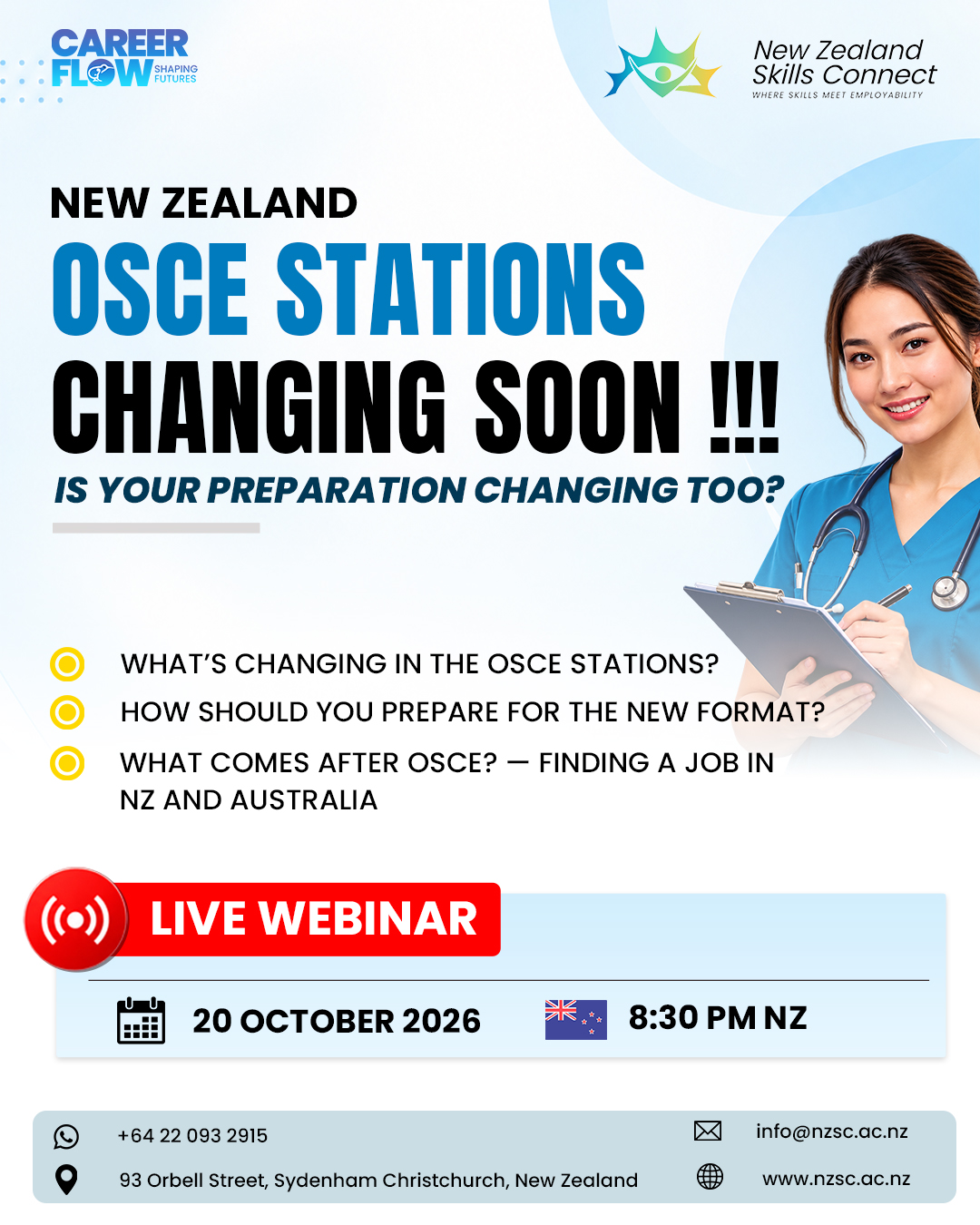
OSCE stands for Objective Structured Clinical Examination. Where the theory exam tests what you know on paper, this one tests what you actually do. You’re placed into a set of simulated clinical scenarios and assessed on how you handle them in real time.
It runs as a circuit of timed stations, 10 of them for registered nurse candidates and 8 for enrolled nurse candidates. At each one you get a couple of minutes to read the scenario, a handful of minutes to work through it, then you move on. There isn’t much room to overthink, which is more or less the point. They want to see how you’d genuinely respond, not how well you’ve memorized a script.
What the assessors are actually watching for is patient assessment, clinical reasoning, how you communicate, your professional judgement, and whether you’re working the way New Zealand expects, including cultural safety. Most candidates go through a short orientation and prep course beforehand too, so the format itself isn’t a surprise on the day.
If you ask nurses who’ve already been through it, the clinical knowledge usually isn’t where they struggled. It’s adjusting to New Zealand’s pace, communication style, documentation habits, and general approach to patient-centered care. That’s the part worth actually preparing for.
If you’ve passed the NCLEX or hold current registration in the US or Canada, include it in your application, since your professional history does count for something. Just don’t treat it as a shortcut. What determines whether you sit the IQN exam or OSCE is your own registration status and recent work experience, looked at individually. NCLEX isn’t part of that equation.
Honestly, this is where most nurses trip up. They assume one solid exam result should count everywhere, but every regulator is protecting the standard of care in its own system, not someone else’s. New Zealand’s assessment is there to check you can practise safely here, not to repeat something you’ve already proven somewhere else.
Knowing NCLEX isn’t required doesn’t tell you what you do need to do next. That answer comes down to your qualification, your current registration, and your work history, and it’s worth sorting out before you spend time or money preparing for the wrong exam.
Connect with our team and we’ll tell you exactly where you stand and what New Zealand actually requires for your registration. And if the IQN exam or OSCE does apply to you, our training programmes are built around what’s actually tested, by people who work through this process with candidates every day.
Exploring Your Options for Nursing Study or Registration in New Zealand?
New Zealand Skills Connect can help you understand the full picture — from study pathways through to OSCE and registration.
to talk through your specific situation.

Leave a Reply