
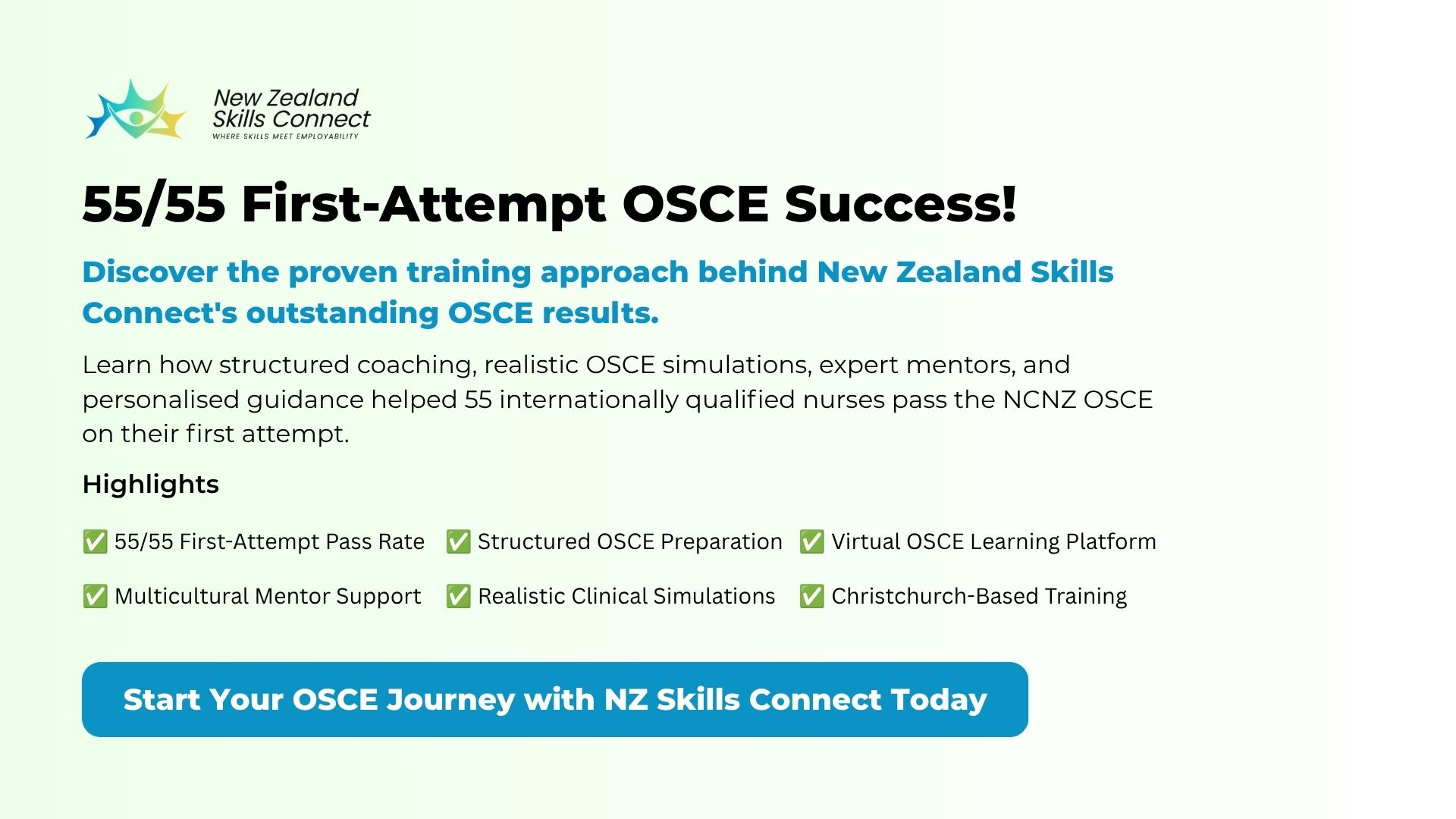
How New Zealand Skills Connect Achieved a 55/55 First-Attempt OSCE Pass Rate
By the Clinical Training Team, New Zealand Skills Connect (NZSC
When 55 internationally qualified nurses (IQNs) sat the Nursing Council of New Zealand (NCNZ) Objective Structured Clinical Examination this cycle, all 55 walked out with a pass — on their first attempt. Not 54. Not “most.” All of them.
We get asked constantly: how do we actually do this? Not the marketing version — the real, unglamorous, structured version. This post is our honest answer. It’s built around the three pillars our candidates tell us mattered most: a structured learning method, a virtual OSCE guide that mirrors the real exam, and multicultural mentor support backed by relationships with New Zealand universities and district hospitals.
If you’re preparing for your OSCE exam first attempt pass and want to understand how we do it — not just that we do it — read on
The NCNZ OSCE is a high-stakes, in-person clinical competence assessment delivered at an approved simulation and assessment centre in Christchurch. Candidates move through multiple timed clinical stations, each requiring them to demonstrate — not simply describe — safe, competent nursing practice at the standard of a New Zealand-registered nurse. Candidates are allowed a limited number of resit attempts, and each resit costs additional time, money, travel, and — often hardest to recover — confidence.
That’s why “first attempt” is the metric that actually matters. A pass rate means little if
Candidates need two or three tries to get there. Our goal from day one has been to get every candidate exam-ready the first time, and our 55/55 result this cycle reflects a training system built specifically for that outcome, not a lucky run
This structure exists because scripted memorisation doesn’t transfer to the exam room.
Real OSCE stations vary the scenario details deliberately, so candidates who only memorise fixed answers get caught out. Our method builds transferable clinical reasoning instead of scripts
- Diagnostic baseline first. Every candidate begins with a skills and communication assessment so we know exactly where their gaps are — clinical reasoning, time management, documentation, or spoken communication under pressure — rather than putting everyone through an identical generic course
- Station-by-station skill building. Instead of broad revision, candidates work through each core competency domain individually (patient assessment, medication safety, deteriorating patient recognition, communication and consent, documentation) until each is independently solid
- Layered integration. Once individual skills are strong, we combine them into full timed scenarios that mirror real exam conditions, so candidates build the specific muscle of performing under a clock, not just knowing the content
- Weekly progress benchmarking. Every candidate is scored against exam-equivalent criteria weekly, so weaknesses are caught and corrected in week two, not discovered on exam day
The single biggest reason candidates fail an OSCE isn’t lack of clinical knowledge — most IQNs are already experienced, practising nurses. It’s the gap between knowing nursing and demonstrating it clearly, safely, and within a tight time limit, in an unfamiliar assessment format.
2. A Virtual OSCE Guide That Removes the Unknown
For most candidates, the biggest source of exam-day failure isn’t clinical skill — it’s unfamiliarity and nerves. Walking into a simulation centre for the first time, under a strict clock, with an examiner silently observing, is a very different experience from clinical practice on the ward.
- Realistic mock stations delivered online, so candidates anywhere in New Zealand — or overseas — can rehearse full station rotations without travelling to a physical centre for every practice session.
- Timed simulation that replicates the structure of real exam stations, including reading time, active scenario time, and movement between stations, so the exam rhythm feels familiar rather than shocking.
- Recorded playback and feedback, allowing candidates to watch their own performance and see exactly where they lose clarity, miss a safety check, or run short on time
- Progressive difficulty, moving candidates from guided practice to fully unprompted, exam-standard scenarios by the final weeks.
Because it’s virtual, candidates in different regions and time zones — including those still working full-time or based overseas — can train consistently without the cost or disruption of relocating early. This is a key reason our online and offline training tracks feed into the same result: readiness, not location, determines the outcome
3. Multicultural Mentor Support, Grounded in Real NZ Clinical Practice
Clinical knowledge alone doesn’t win an OSCE station. Communication does — and
communication is culturally shaped
Many of our candidates trained and practised nursing in healthcare systems with very
different communication norms, documentation styles, and patient interaction
expectations than those used in Aotearoa New Zealand. A candidate who is clinically
excellent can still lose marks by under-explaining to a patient, missing a culturally
expected step in consent, or communicating in a way that reads as uncertain rather than confident to a New Zealand examiner.
- Mentors from diverse clinical and cultural backgrounds, many of whom have supported IQNs through NZ registration themselves, so candidates are coached by people who understand both where they’ve come from and what New Zealand practice expects.
- Explicit training in New Zealand’s culturally safe practice expectations, including communication style, patient-centred explanation, and the principles of Te Tiriti o Waitangi that underpin the NCNZ’s approach to safe practice
- One-on-one feedback loops, not just group classes, so communication habits that don’t translate well to the NZ context are identified and corrected early, well before exam day
- Peer community support, connecting candidates with others who have already passed, so preparation doesn’t happen in isolation
Backed by Real Connections to New Zealand Universities and District Hospitals
Training in a vacuum doesn’t prepare anyone for real practice. Our programme is anchored by relationships with New Zealand universities and district hospitals, which means our training content, clinical scenarios, and communication standards are continually checked against what’s actually expected in New Zealand healthcare settings — not just what’s expected in an exam room.
These connections give candidates two things a purely exam-focused course can’t:
exposure to genuine New Zealand clinical culture and a realistic sense of the workplace they’re training to enter. That context matters in an assessment specifically designed to test whether a candidate can safely practise in the New Zealand system.
We run both online and offline (in-person) OSCE training, and we deliberately hold both to the same standard rather than treating online as a lighter-touch option
- Offline training gives candidates hands-on simulation practice, in-person mentor coaching, and the physical rehearsal of moving between stations under time pressure.
- Online training gives candidates flexibility, virtual mock stations, and mentor feedback without requiring relocation before they’re ready
Most candidates use a mix of both: building foundational skills and communication habits online, then finishing with intensive in-person mock exams closer to their test date. The result is the same regardless of track — full readiness before the real OSCE, not partial preparation topped up with hope.
The Real Takeaway Behind “55 out of 55”
We don’t share this result to claim a shortcut exists. There isn’t one. What we’ve built is a
training system that treats the OSCE exam first attempt pass as the actual goal — not a
hoped-for bonus — and structures every part of preparation around it: diagnosing gaps early, rehearsing under real exam conditions, and coaching communication as seriously as clinical skill.
If you’re preparing for your NCNZ OSCE and want a structured, honest, first-attempt
focused plan — whether that’s online, offline, or both — that’s exactly what New Zealand
Skills Connect is built to do
The Real Takeaway Behind “55 out of 55”
It means our training is specifically structured so candidates are ready to pass on their very
first sitting, rather than treating a resit as an expected part of the process.
Used correctly, yes — our Virtual OSCE Guide replicates timed station conditions and gives
detailed feedback, and most candidates combine it with in-person mock exams closer to
their test date for the strongest result.
Because the OSCE assesses communication as much as clinical skill, and communication
norms differ by culture. Mentors who understand both a candidate’s background and New
Zealand’s clinical communication expectations can identify and fix gaps that purely clinical
coaching would miss.
No. Our online track lets candidates begin structured preparation, including virtual mock
stations and mentor feedback, before relocating for in-person practice and the exam itself
Getting started
Join the training program trusted by internationally qualified nurses preparing for the NCNZ OSCE. Learn with expert mentors, practise real exam scenarios, and build the confidence to succeed.

Leave a Reply