
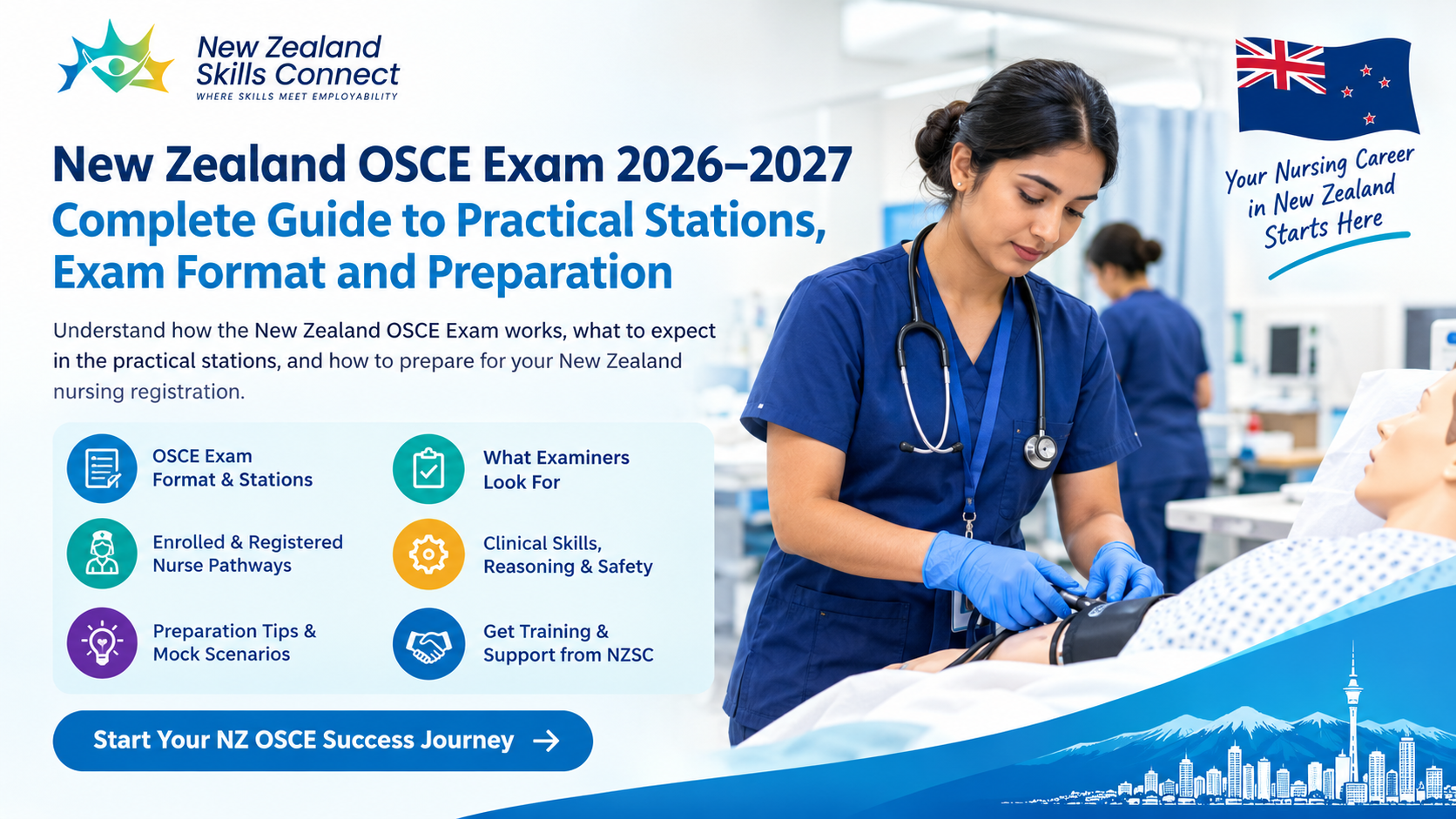
What Is the New Zealand OSCE Exam?
The Objective Structured Clinical Examination (OSCE) is a test of clinical skill for nurses who are qualified elsewhere and want to register in New Zealand when the Nursing Council of New Zealand (NCNZ) requires it. Unlike a written test the OSCE looks at how nurses use their knowledge carry out hands‑on nursing tasks talk to patients and make safe decisions in simulated health care settings. Candidates may have to finish the IQN Theory Exam and other steps before they can take the clinical skill test. Knowing the New Zealand OSCE Exam format what the examiners look for and what is expected in practice helps nurses from countries prepare better for their New Zealand nursing registration.
New Zealand Skill Connect OSCE Training 2026–2027
878 Nurses Joined OSCE Training
For the 2026–2027 training period New Zealand Skill Connect (NZSC) says that 878 nurses joined its OSCE training program and shows a 98% pass rate for the OSCE. These numbers should come from verified enrolment and exam result records showing the period and how many candidates actually sat for the exam. A high pass rate does not mean every candidate will pass. NZSC helps qualified nurses by giving structured lessons, real demonstrations, simulated clinical scenes and guided practice to help them learn New Zealand nursing standards and build confidence before the exam.
New Zealand OSCE Exam. Duration Registered Nurse and Enrolled Nurse OSCE Stations
The practical OSCE takes place in a clinical setting where candidates must show their skills instead of just saying what they would do. The exam layout depends on the nurse’s registration path: under NCNZ rules registered nurse candidates complete 10 stations while enrolled nurse candidates complete 8 stations. Each station lasts 12 minutes with 2 minutes to read the instructions, 8 minutes to perform the task and 2 minutes to move to the next station. Candidates go through their assigned stations follow the directions and show professional and patient‑focused nursing work within the time limit.
Eight Practical OSCE Stations Explained Mental Health Assessment, Vital Signs and Care Planning
The eight stations for enrolled nurses cover health assessment, vital signs, assessment and care planning professional responsibility, emergency management, clinical skills, medication administration and communication, teamwork and escalation of care. Depending on the scenario candidates may need to check a patient’s condition take signs, spot clinical issues plan suitable nursing care perform relevant procedures follow medication safety rules respond to an emergency or share concerns with the health team. These are the areas the exam covers, not a fixed list of questions. Registered nurse candidates should study the registered nurse exam format and the requirements set by NCNZ.
Good OSCE preparation is more than memorising answers or practicing tasks. Nurses must build reasoning, habits to prevent infection ways to identify patients ways to get consent clear talking, proper record keeping, cultural safety and the skill to spot and raise a patient who is getting worse. New Zealand Skill Connect (NZSC) offers OSCE prep through demonstrations, mock scenes, clear guidance and chances to practice clinical talking and decision making. This approach helps qualified nurses find areas to improve, get used to timed stations and practice using nursing knowledge in situations that match New Zealand clinical expectations. Candidates should also read the official NCNZ handbook because the exam rules can change.
Preparing early can give qualified nurses more confidence and a better idea of what examiners will look at in the New Zealand OSCE Exam. Before booking an exam candidates should check that they are eligible follow the steps in their NCNZ application and finish the required theory exam or other assessment steps that fit their path. Nurses who want help can look at the training options from New Zealand Skill Connect, which include practical OSCE support and advice for internationally qualified nurses. Visit New Zealand Skill Connect to learn more about the programs that’re available and take the next step, toward preparing for New Zealand nursing registration.
Exploring Your Options for Nursing Study or Registration in New Zealand?
New Zealand Skills Connect can help you understand the full picture — from study pathways through to OSCE and registration.
to talk through your specific situation.

Leave a Reply