
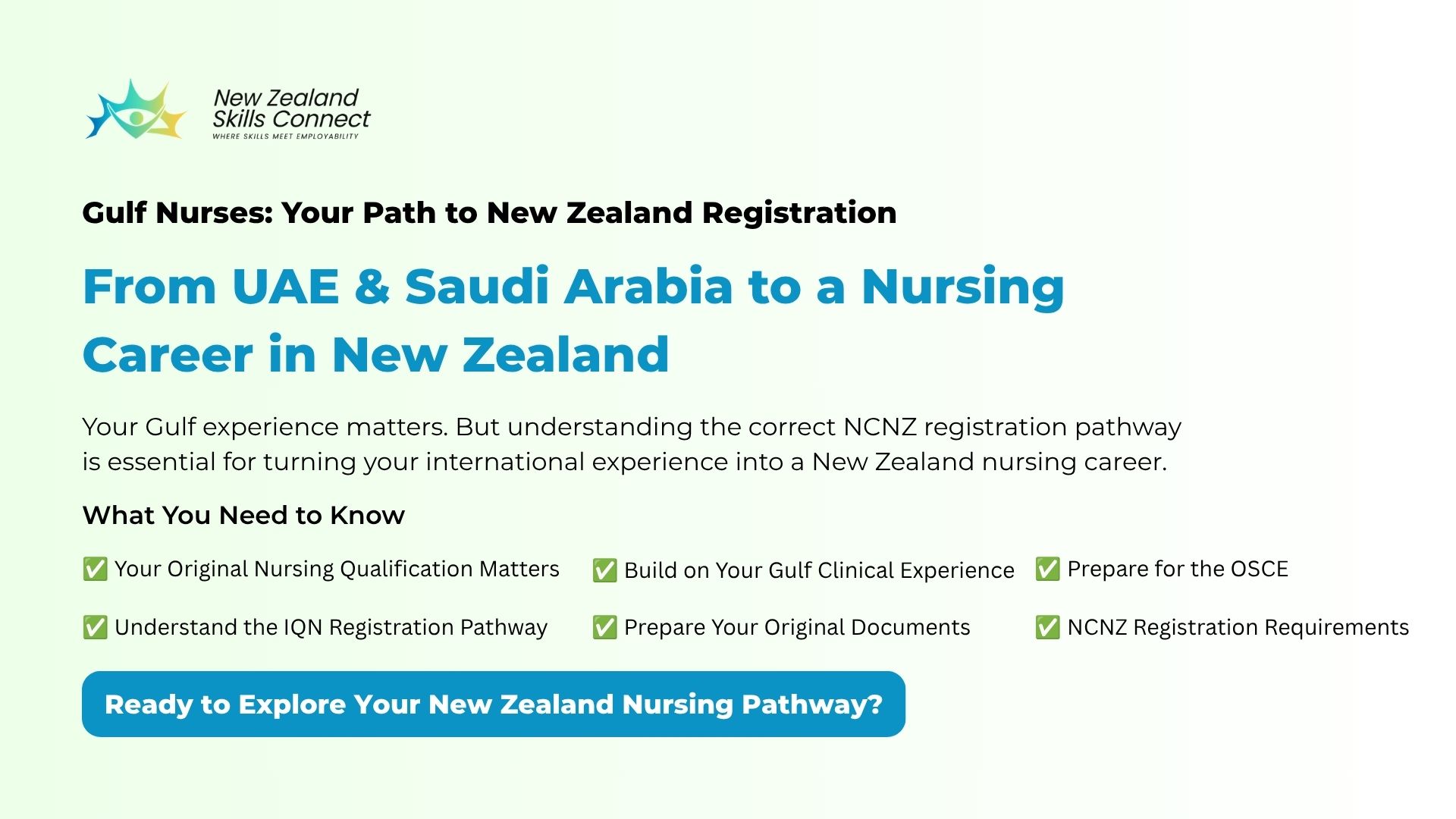
Gulf Nurses (UAE & Saudi Arabia): Your Path to New Zealand Registration
Nurses working in the UAE and Saudi Arabia are often among the most clinically experienced internationally qualified candidates applying to New Zealand — many have spent years in fast-paced, high-acuity hospital environments across Dubai, Abu Dhabi, Riyadh, and Jeddah. That experience is genuinely valuable, but the registration pathway into New Zealand still requires a specific, structured process regardless of your current role or seniority in the Gulf.
Your original qualification still matters most
If you originally trained in India, the Philippines, Pakistan, or another country before moving to the Gulf, New Zealand’s Nursing Council (NCNZ) assesses your Original Nursing Qualification, not your years of Gulf employment. Gulf clinical experience is genuinely useful for your OSCE preparation and your eventual job applications, but it doesn’t replace the assessment of your base qualification.
Practical tip: gather your original transcripts and registration documents now, even if they’re several years old — they’ll be needed regardless of how long you’ve worked in the UAE or Saudi Arabia since.
NCNZ reviews your original nursing qualification against New Zealand’s competency standards. If there are gaps — often around scope of practice differences between Gulf hospital systems and NZ’s model of nursing — these get identified at this stage, before you invest in exam preparation.
Most nurses who’ve worked in the UAE or Saudi Arabia for several years in English-speaking clinical teams find this step manageable, but NCNZ still requires an approved test score (typically IELTS or OET) unless you meet specific exemption criteria. Check current thresholds directly with NCNZ, as exemptions and required bands are reviewed periodically.
The OSCE tests real clinical skills in a simulated New Zealand ward setting, and this is where Gulf nurses have a genuine advantage: high-acuity clinical exposure builds strong assessment and decision-making instincts. But there are real differences to prepare for:
- Documentation and handover formats differ from Gulf hospital systems — NZ uses specific structured formats like ISBAR that need deliberate practice.
- Patient communication style in New Zealand tends to be more collaborative and explanation-driven than some Gulf hospital environments, and examiners specifically assess this.
- Scope of practice differences — some tasks that are delegated differently in Gulf systems (medication administration protocols, for example) are assessed strictly against NZ standards.
Nurses coming from the Gulf who prepare specifically for these format and communication differences — rather than assuming strong clinical experience alone is enough — consistently see better first-attempt OSCE outcomes.
Once registration is on track, most Gulf-based nurses start planning the practical side of relocation in parallel — visa category, timing around notice periods with current Gulf employers, and researching regions of New Zealand with strong nursing demand (Auckland, Christchurch, and Wellington all regularly recruit internationally qualified nurses). Starting this research early, alongside your registration process, shortens the overall timeline to working in New Zealand.
With NCNZ registration confirmed, you’re eligible to apply directly to New Zealand hospitals and healthcare providers, many of which actively recruit internationally qualified nurses with Gulf hospital experience given the exposure to high patient volumes and acute care settings.
What makes the Gulf-to-NZ move different from a direct move?
The biggest practical difference is timing coordination — you’re managing an active job and often a family relocation from the UAE or Saudi Arabia at the same time as an exam and registration process. Nurses who succeed with this transition tend to:
- Start OSCE preparation while still working in the Gulf, rather than waiting until after resignation
- Confirm visa requirements early, since processing times can run in parallel with exam preparation
- Connect with training providers who understand both the Gulf clinical background and the specific NZ exam format
A realistic timeline
Qualification assessment and English testing typically take a few months. OSCE booking and preparation adds further time depending on demand and your preparation pathway. Most Gulf-based nurses who start the process with a clear plan are working in New Zealand within 6–12 months.
Preparing for OSCE while still working in the UAE or Saudi Arabia?
New Zealand Skills Connect offers structured OSCE training designed around the schedules of nurses relocating from the Gulf.
to discuss your qualification and preparation timeline.

Leave a Reply